Why is my garage door stuck halfway open in Tampa
A garage door stuck halfway open in Tampa almost always means a broken torsion spring, a snapped cable, or an off-track roller. Here's how to diagnose it.
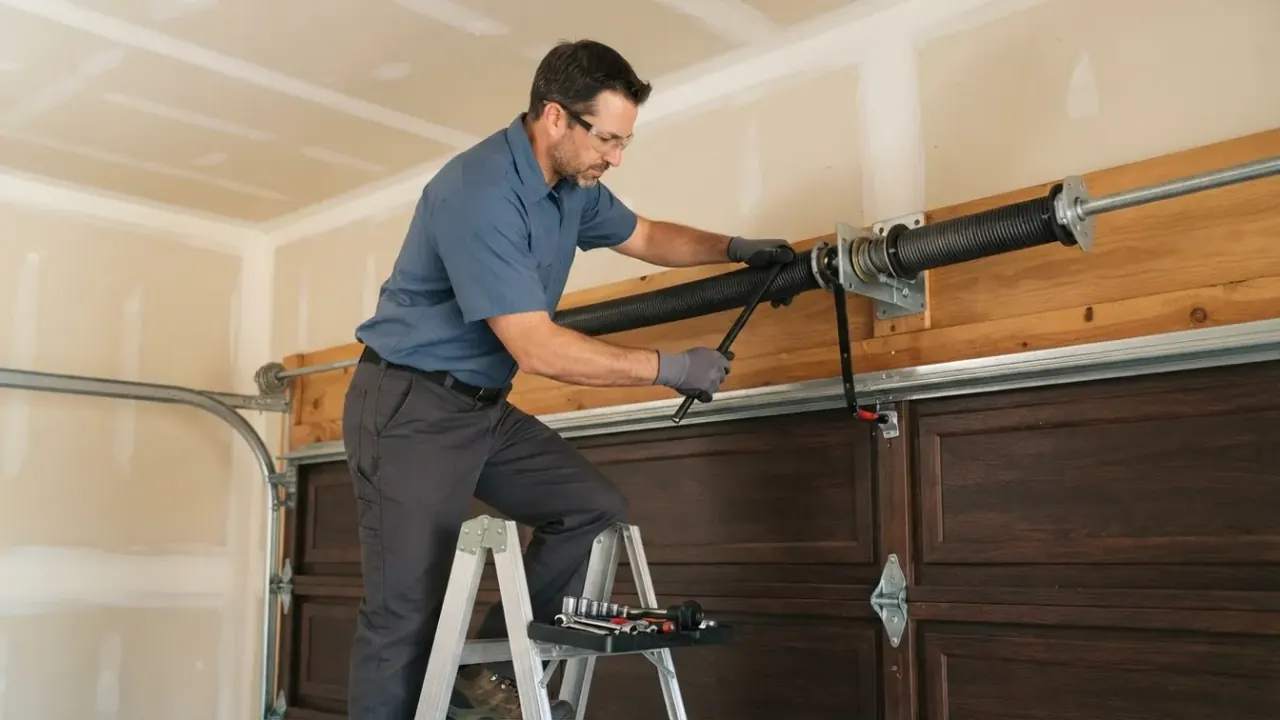
A garage door stuck halfway open in Tampa is almost always caused by a broken torsion spring, a snapped lift cable, or a roller that has jumped the track. The door rises a foot or two, the spring or cable gives out, and gravity slams it back down - or the opener strains and quits mid-travel. In this post we break down each cause, how Tampa's heat and humidity accelerate the failure, and what you can safely check before calling us.
We fix these every week across Hillsborough County, and the pattern is consistent: the door is not "stuck" - something in the lifting system has physically failed. Knowing which part failed tells you whether it's a same-day repair or a full replacement.
The most common reasons a Tampa garage door stops halfway
In our Tampa service calls, a door that stalls halfway traces back to one of five parts. The torsion spring carries the full weight of the door - roughly 130 to 250 pounds on a standard two-car door - and when it snaps, the door becomes too heavy for the opener to lift. That is the number one cause we see.
Here is the breakdown, ranked by how often we find each one:
- Broken torsion spring - you'll hear a loud bang from the garage, and the door won't budge more than a few inches.
- Snapped lift cable - the door rises crooked, one side higher than the other, then jams.
- Roller off the track - the door travels a foot or two and stops with a grinding or scraping noise.
- Opener gear or logic board failure - the motor hums but the trolley doesn't move, or the door reverses immediately.
- Misaligned safety sensor - the door starts down, then snaps back up within two seconds.
If your door is stuck with the bottom section hanging off the rail, that's a different problem - we cover it in our guide to garage door off track repair in Tampa, where a derailed door needs to be reset before anything else.
Why does my garage door get stuck halfway open?
A garage door gets stuck halfway open because the lifting mechanism loses its ability to counterbalance the door's weight. Springs and cables work as a team: the spring stores energy as the door closes and releases it as the door opens, so the opener only has to push about 10 to 15 pounds. When the spring breaks, that counterbalance disappears and the opener - rated for a fraction of the door's real weight - stalls out.
Here's what happens in sequence when a torsion spring fails:
- The door starts to rise normally.
- At roughly 12 to 18 inches of travel, the spring's remaining coils unwind and the door's full weight transfers to the opener.
- The opener's safety clutch slips, or the motor overheats and shuts off.
- The door stops - often hanging at a slight angle.
That's why a door stuck halfway is rarely an opener problem, even though the opener is what quit. The opener is the messenger, not the cause.
Tampa heat, humidity, and salt air make it worse
Tampa's climate is brutal on garage door hardware. Summer attic temperatures inside a closed garage routinely hit 130°F to 150°F, and that heat cycles the torsion spring thousands of times a year. A spring rated for 10,000 cycles can fail in seven to nine years here instead of the 12 to 15 years you'd see in a milder climate.
Humidity does the rest. Coastal air from Tampa Bay and the Gulf carries salt that pits rollers, hinges, and the bottom bracket. We see rollers seize up at five to six years old in neighborhoods like Westchase, South Tampa, and Apollo Beach - the bearings rust solid and the door drags instead of rolling.
If you live within a mile of the bay, plan on a garage door lubrication in Tampa every six months rather than once a year. A $95 to $150 tune-up is cheaper than replacing seized rollers and a stretched cable.
How to tell which part failed
You can narrow down the cause in about two minutes without touching anything dangerous. Stand inside the garage, close the door, and look at the hardware above the door and along the tracks.
Check the torsion spring first
Look at the horizontal shaft above the door. If you see a clean gap in the coil - a two-to-three-inch break in what should be a continuous spring - it's snapped. Do not try to open the door. A door with a broken spring can come crashing down.
Check the cables
Look at the bottom corners of the door where the cables attach. A snapped cable will be dangling loose or wrapped around the drum. If one cable is slack and the other is tight, the door will rise crooked - that's a clear cable failure.
Check the rollers and track
Run your eyes along both vertical tracks. A roller that has popped out of the track will be sitting outside the channel, and you'll usually see a bend in the track where it happened. This is common after a car bumper taps the door or after a bad storm.
Check the opener
Press the wall button. If you hear a hum but the door doesn't move, the opener's gear or drive belt is stripped. If the door moves down an inch and reverses, the safety sensor is misaligned or the down-limit is off. Our team handles both under garage door opener repair in Tampa.
What to watch out for (and what not to do)
The biggest mistake homeowners make with a stuck door is forcing it. Pulling the red emergency release and trying to lift a door with a broken spring can drop 200 pounds of door on you. Torsion springs are under extreme tension - a DIY replacement without the right winding bars is how people end up in the ER.
Other things we see that turn a small repair into a big one:
- Running the opener repeatedly. Every cycle with a broken spring burns the motor and can strip the plastic drive gear - a $180 repair becomes a $450 opener replacement.
- Spraying WD-40 on the springs. It attracts dust and gums up the coils. Use a lithium- or silicone-based lubricant on rollers and hinges only.
- Ignoring a slow, jerky door. A door that hesitates is telling you a spring is losing tension or a roller is seizing. Fix it now, not after it fails at 7 a.m. on a workday.
- Replacing one spring when you have two. Torsion systems almost always use paired springs. Replacing one leaves the door unbalanced and shortens the life of the new spring.
If your door is more than 15 years old and this is the second or third major repair, it may be time to weigh repair against replacement. We walk through the numbers in our garage door replacement in Tampa guide - most homeowners break even on a new door in six to eight years once you factor in energy savings and resale value.
When to call a professional
Call a professional the moment you see a gap in the torsion spring, a dangling cable, or a door hanging off the track. Those three failures are not DIY repairs - they involve stored energy that can cause serious injury, and a wrong fix can drop the door on a car or a person.
Our technicians carry replacement springs, cables, and rollers on every truck, so most stuck-door calls in Tampa are resolved in a single visit. We test the door through three full open-and-close cycles before we leave, and we set the opener's force and travel limits so the door runs smoothly.
If you're not sure what's wrong, describe what you see and hear when you call. Nine times out of ten we can tell you the likely cause and what the repair will cost before we arrive.
Frequently Asked Questions
How much does it cost to fix a garage door stuck halfway in Tampa?
Most stuck-door repairs in Tampa run $180 to $350 in 2026, depending on the part. A torsion spring replacement is typically $250 to $350 for a two-car door, a cable replacement $150 to $250, and a roller reset $95 to $175. We quote the price before we start.
Can I open a garage door with a broken spring?
No. A door with a broken torsion spring weighs 130 to 250 pounds and has no counterbalance. Lifting it by hand can cause the door to crash down. Leave it closed and call for service - we can usually be there the same day.
Why does my garage door go up a little then stop?
That pattern almost always means a broken spring or a snapped cable. The opener lifts the door until the counterbalance fails, then the motor's safety clutch slips and the door stops. It is not an opener problem - the opener is doing its job by quitting.
How long do garage door springs last in Tampa?
Seven to nine years in Tampa, versus 12 to 15 in cooler climates. The heat cycling inside a closed garage - often 130°F or higher in summer - wears springs out faster. If your door is eight years old and making noise, have the springs inspected.
Will my homeowners insurance cover a stuck garage door?
Only if the damage came from a covered event like a storm, a vehicle impact, or a fallen limb. Normal wear - a broken spring or worn roller - is a maintenance item and is not covered. Check your policy's exclusions before filing a claim.
Get help with garage door repair in Tampa
If your door is stuck halfway and you're not sure why, we can diagnose it over the phone and get a technician to your driveway - often the same day. We stock springs, cables, rollers, and openers on every truck, so most repairs are done in one visit.
Call +17739156384 and tell us what you're seeing. We'll give you a straight answer and a price before we start.